



If you've been wanting to start your fitness journey, but don't know where to begin, this article is for you. With so much advice available, it's easy to feel like you need expensive equipment or the "perfect" workout plan before you can begin. But getting started is simpler than you think.
You can build strength at home with very little equipment, and you don't need to know every exercise before you get started. What matters most is building a routine you can stick to and gradually challenging your muscles over time.
In this article, I'll explain how to start strength training at home, what you actually need, and how to build a simple routine that helps you make steady progress.
Can you build strength at home?
Yes. You can build strength at home using bodyweight exercises or simple equipment. A gym gives you access to more equipment and variety, while home workouts can be a practical way to start or keep training when it suits your schedule.
Your muscles respond to challenge. That challenge can come from:
- Your own body weight
- Resistance bands
- Dumbbells
- Kettlebells
- Everyday household items, such as a backpack filled with books
I've worked with plenty of people who thought training at home would hold them back. A few months later, they were stronger, more confident and moving with much more ease. Their progress came from training consistently and gradually increasing the challenge.
Home workouts can be a great place to start because they're convenient, affordable and easy to fit around a busy schedule. You can also combine them with gym sessions when you want access to more resistance, equipment or exercise options.
What do you need to start strength training at home?
Probably less than you think. To get started, all you really need is:
- A small amount of floor space
- Comfortable clothes
- A little time
Bodyweight exercises alone can help you build strength, especially when you're new to training. If you want to add variety later, a pair of adjustable dumbbells or a set of resistance bands can give you plenty of options without taking up much space.
Don't wait until your setup is perfect. It's far better to complete two simple workouts each week than to keep postponing your first session because you think you need more equipment.
Build your home strength routine in 3 simple steps
Step 1: Train your whole body
Instead of focusing on one muscle group each day, I recommend my beginner clients start with full-body workouts. This allows you to practise the main movement patterns more often while giving each muscle enough time to recover.
In the Basic-Fit app, you’ll find training plans for home workouts and guided video sessions you can follow wherever you are. That way, you always know what to do next.
Step 2: Focus on the basics
Choose one exercise for each of these movement patterns:
- Push
- Pull
- Squat
- Hinge
- Core
Covering these patterns helps you build balanced strength across your whole body.
Step 3: Keep it manageable
Aim for two or three sessions each week. Each workout can last around 30 to 45 minutes.
That might look like:
- Bodyweight squats – 3 × 10–12
- Push-ups (or incline push-ups) – 3 × 8–10
- Glute bridges – 3 × 12–15
- Resistance band rows – 3 × 10–12
- Plank – 3 × 30 seconds
As you become stronger, you can gradually make each exercise more challenging.
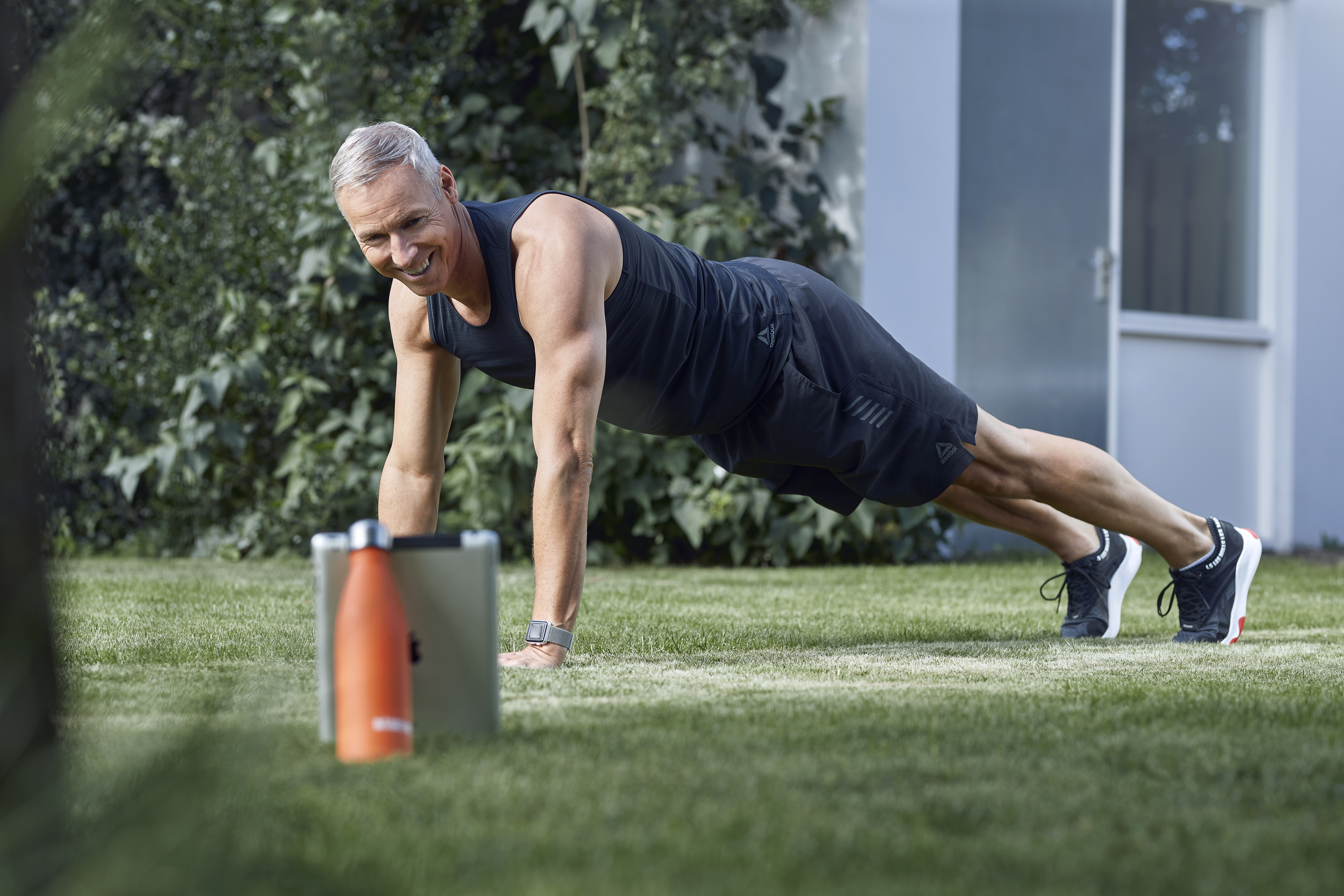
What exercises should you start with?
Focus on movements that train multiple muscle groups at once. Some of my favourite beginner-friendly exercises include:
Squats
Build strength in your legs and glutes while improving everyday movements like sitting down and standing up.
Push-ups
Strengthen your chest, shoulders and arms. If regular push-ups feel too difficult, start with your hands on a bench or table.
Glute bridges
Strengthen your glutes and hamstrings while helping improve hip stability.
Rows
Whether you use resistance bands or dumbbells, rows strengthen your upper back and help balance pushing exercises.
Planks
Build core strength and stability that supports many other exercises.
One thing I notice a lot is that people who are new to fitness worry about choosing the 'perfect' exercise. In reality, the best exercises are usually the ones you can perform with good technique and continue doing consistently.
Try this strength workout at home
Ready to put the basics into practice? Follow along with this video workout at your own pace and focus on moving with control.
How often should you train?
For most beginners, two or three strength training sessions each week is enough. Your muscles don't get stronger during the workout itself. They get stronger while recovering afterwards. That means recovery is just as important as training.
If you're new to strength training, it's often better to finish a workout feeling like you could have done one more exercise rather than pushing yourself to complete exhaustion. Building consistency is far more valuable than having one extremely hard workout every now and then.
How do you make progress over time?
Once an exercise starts feeling easier, it's time to increase the challenge. This is known as progressive overload, which simply means gradually asking your muscles to do a little more over time.
You could:
- Perform a few extra repetitions
- Add another set
- Use slightly heavier weights
- Slow down the movement
- Choose a more challenging variation
Tracking your workouts can also help. Writing down your exercises, repetitions and weights makes it easier to see your progress and know when you're ready for the next step.
Common mistakes when strength training at home
Starting is often the hardest part, but a few common mistakes can slow your progress.
Doing too much too soon
It's tempting to train every day when motivation is high, but your body needs time to recover.
Changing your workouts every week
Progress comes from repeating exercises long enough to become stronger at them.
Overcomplicating your routine
You don't need 15 different exercises in one workout. A handful of well-chosen movements is enough.
Expecting fast results
Strength develops gradually. Small improvements each week add up over time.
Being inconsistent
Missing the occasional workout isn't a problem. Giving up altogether is.
When is it time to add more challenge?
Your current routine is probably working well if:
- Exercises feel challenging while maintaining good technique.
- You're gradually performing more repetitions or using more resistance.
- You recover well between workouts.
You might be ready for more challenge if:
- You easily complete every set.
- Your workouts no longer feel demanding.
- You're looking for more variety or have new fitness goals.
You could add resistance bands, dumbbells or more challenging exercise variations at home. You can also take some sessions to the gym, where heavier weights and a wider range of equipment give you more ways to progress.
Home and gym workouts can work well together. The right balance depends on your schedule, experience and goals.
Final thoughts
Strength training at home is one of the easiest ways to get started. You don't need expensive equipment, complicated programmes or years of experience before your first workout. Start with a few simple exercises, train consistently, and gradually increase the challenge as you become stronger.
From my experience, the people who see the most progress aren't the ones with the perfect setup. They're the ones who keep showing up, even when the workouts are simple. Start where you are, use what you have, and focus on building habits that you'll still enjoy months from now.
This article is for general information only. Individual needs can vary depending on health status, training experience, and personal goals. If you have a medical condition or specific health concerns, consider seeking advice from a qualified healthcare professional


