


When you start weight training, you will hear terms like compound exercises and isolation exercises.
They may sound unfamiliar, but the idea is simple. Some exercises train several muscles at the same time (compound), others focus on one specific muscle (isolation).
Both can be very useful!
In this article, you’ll learn:
- what compound exercises are
- what isolation exercises are
- how they support different training goals
- how to choose exercises that match your level
- and how to combine them in a simple strength workout
What are compound exercises?
Compound exercises are movements where multiple joints and muscle groups work together.
For example, during a squat, you use your knees, hips and ankles. Your quads, glutes, hamstrings, core and back all help in different ways.
Other examples of compound exercises are:
- deadlift
- leg press
- bench press
- chest press
- shoulder press
- row
- lat pulldown
- pull-up
These exercises are often used as the foundation of a strength training program because they allow you to train several muscles at once.
They are also efficient. If you do a chest press, you don’t only train your chest. Your shoulders and triceps also help. If you do a row, your back works together with your biceps and rear shoulders.
That makes compound exercises useful when your goal is to get stronger, build muscle, or create a balanced routine.
What are isolation exercises?
Isolation exercises focus on one specific muscle group and usually involve one main joint.
For example, during a bicep curl, the main movement happens at the elbow. The focus is mostly on the biceps.
Examples of isolation exercises are:
- bicep curl
- tricep pushdown
- leg extension
- leg curl
- lateral raise
- cable kickback
- calf raise
- pec deck
- hamstring curl
Isolation exercises are useful when you want to give extra attention to one muscle.
For example:
- leg extension for your quads
- leg curl for your hamstrings
- lateral raise for your side shoulders
- tricep pushdown for your triceps
They can also help you as a beginner to learn what a specific muscle would feel like during training. If you struggle to feel your chest in a chest press, a machine fly can help you understand that muscle better.
What are the differences between compound and isolation exercises?
Here’s a simple comparison:
| Compound exercises | Isolation exercises |
|---|---|
| Multiple muscles | Mostly one muscle |
| Multiple joints | Usually one main joint |
| Efficient for full-body strength | Useful for specific muscle focus |
| Often more demanding | Often easier to control |
| Great as a foundation | Great as an addition |
Compound exercises train everyday movements like: Stand up, Push away, Pull towards yourself or Lift something. Every muscle that you use in this movement will get stronger and will grow to some extent.
Isolation exercises move one joint and one muscle. You use them to strengthen a weak point, improve control, or give extra attention to a muscle group that is lagging behind.
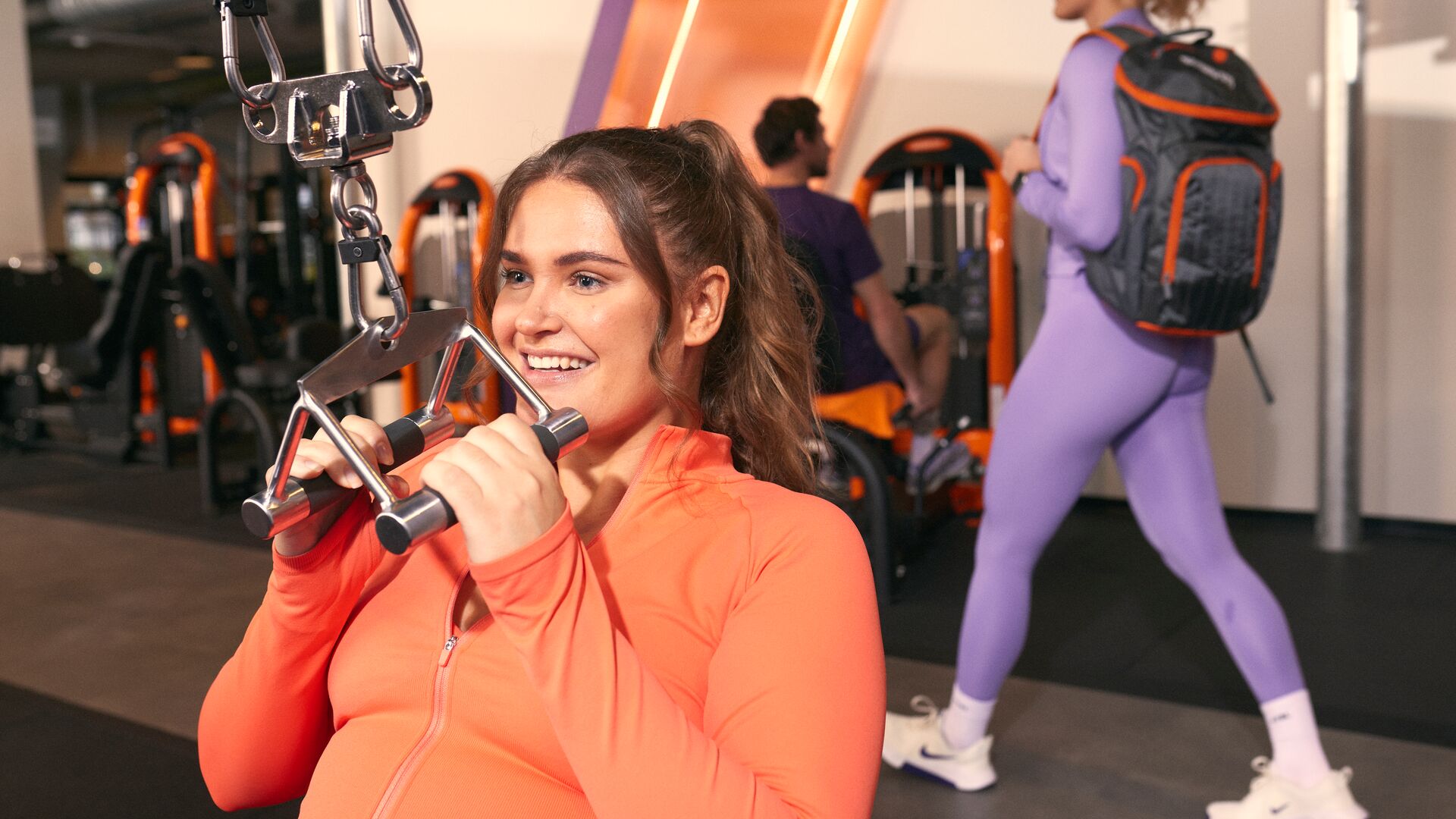
For example, rows and pulldowns train your back and biceps together.
But if your goal is to grow your biceps specifically, a bicep curl gives that muscle more direct focus.
They simply have different roles.
Which one is better for strength?
The follow up question should be: In what kind of way do you want to develop strength? Some people want to be strong for their job, others want to be strong for their sport (bench press or strongman for example).
But if your goal is overall strength, compound exercises usually form the foundation.
That’s because they allow you to use more muscle mass and often move more weight. This makes them useful for building overall strength.
For example:
- a chest press will usually allow more load than a tricep pushdown
- a leg press will usually allow more load than a leg extension
- a row will usually allow more load than a bicep curl
But this does not mean isolation exercises are unimportant.
Isolation exercises can support strength training by helping weaker muscles catch up. They can also add extra training volume without making every exercise very demanding.
A good strength training routine often includes both:
- compound exercises for the main work
- isolation exercises for extra focus and support
Are compound and isolation exercises beginner-friendly?
Both compound and isolation exercises can work well for beginners.
Some compound exercises are easy to learn and control, while others require more balance and technique.
For example:
- A leg press is a compound exercise that is stable and beginner-friendly.
- A barbell squat is also a compound exercise, but it usually takes more practice.
- A Bulgarian split squat can be effective, but many beginners find it challenging at first.
That doesn't make these exercises better or worse. It simply means some may be easier starting points than others.
Isolation exercises are often easier to learn because they focus on one muscle group at a time.
For example:
- A leg extension targets the quads.
- A leg curl targets the hamstrings.
- A bicep curl targets the biceps.
- A lateral raise targets the side shoulders.
For many beginners, a combination of compound and isolation exercises works best. Compound exercises help build overall strength, while isolation exercises help you focus on specific muscles and improve exercise control.
The best exercises are the ones you can perform safely, with good technique, and progress over time.
How to combine compound and isolation exercises
A simple approach is to start your workout with compound exercises and finish with isolation exercises.
Compound exercises usually require more energy, focus and coordination. That's why they often work best at the start of a workout.
Isolation exercises can be added later when you want to give extra attention to a specific muscle group.
For example, an upper-body workout could look like this:
- Chest press (compound)
- Seated row (compound)
- Shoulder press (compound)
- Lat pulldown (compound)
- Lateral raise (isolation)
- Triceps pushdown (isolation)
- Bicep curl (isolation)
This approach lets you perform the bigger exercises while you're fresh and finish with more targeted work.
There are exceptions. If a specific muscle is a priority, you may choose to train it earlier in your workout.
Example beginner strength workout
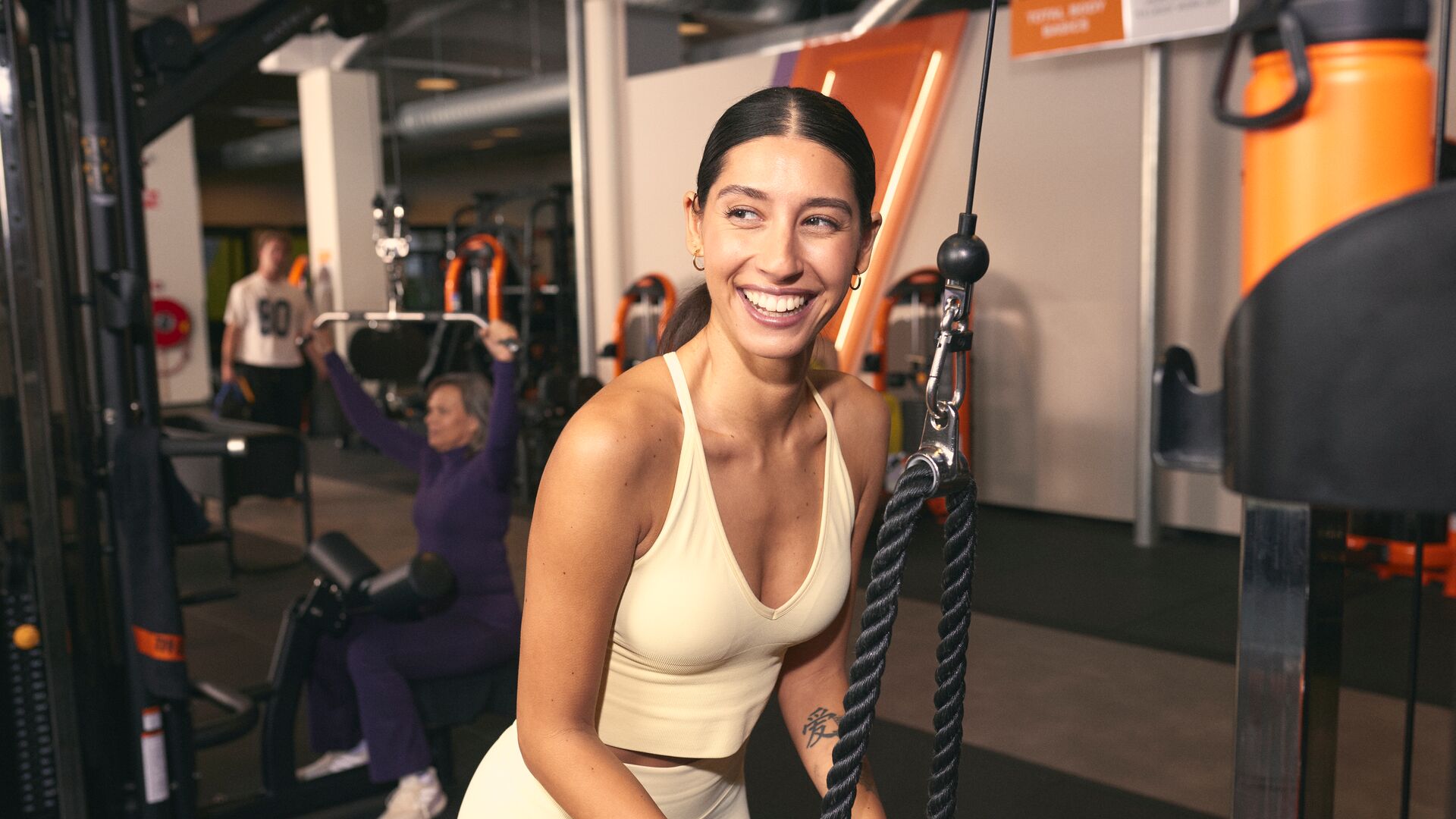
Here is a simple full-body workout using both compound and isolation exercises.
- Leg press:
Compound exercise
Trains: quads, glutes, hamstrings - Chest press:
Compound exercise
Trains: chest, shoulders, triceps - Seated row:
Compound exercise
Trains: back, biceps, rear shoulders - Romanian deadlift:
Compound or focused lower-body movement
Trains: hamstrings, glutes, back stability - Lateral raise:
Isolation exercise
Trains: side shoulders - Leg curl:
Isolation exercise
Trains: hamstrings - Tricep pushdown or bicep curl:
Isolation exercise
Trains: arms (triceps or bicep)
A good starting point is:
- 2 to 3 sets per exercise
- 8 to 12 repetitions
- controlled technique
- enough rest between sets (1.5 – 3 minutes)
- gradual progress over time
Common mistakes beginners make
1. Doing only isolation exercises
Isolation exercises can feel clear and controlled, which is helpful. But if your whole workout is made up of small movements, you may miss the strength benefits of bigger exercises.
A better approach is to build your workout around a few compound exercises first, then add isolation exercises where needed.
2. Choosing exercises that are too complex
Some exercises look impressive, but that does not mean they are the best choice right now.
If you cannot control the movement, target the right muscles, or use enough load safely, choose a simpler variation.
Simple does not mean easy.
Simple often means effective.
3. Forgetting progression
Doing the same weight and reps forever will eventually limit your progress.
Try to improve gradually. That could mean:
- one extra repetition
- slightly more weight
- better control
- better range of motion
Progress does not need to be fast, but it needs to be consistent.
Tracking your workouts in the Basic-Fit app can help you see your progress over time.
Conclusion
Compound and isolation exercises both have a place in strength training.
Compound exercises help you build a strong foundation because they train multiple muscles at the same time. Isolation exercises help you focus on specific muscles and add extra detail to your routine.
If you're unsure which exercises fit your goal, a personal trainer can help you build a routine that works for you.
The best workout is the one you can perform well, repeat consistently and progress over time.
This article is for general information only. Individual needs can vary depending on health status, training experience, and personal goals. If you have a medical condition or specific health concerns, consider seeking advice from a qualified healthcare professional


