


Hypertrophy training means training with the goal of building muscle. You may have heard all sorts of advice about muscle growth, from lifting heavy weights to feeling sore after a workout or getting a muscle pump. But it's not always clear what actually makes your muscles grow.
Understanding how muscle growth works can help you make sense of your workouts and train with confidence. Here's what you need to know to get started.
What does hypertrophy mean?
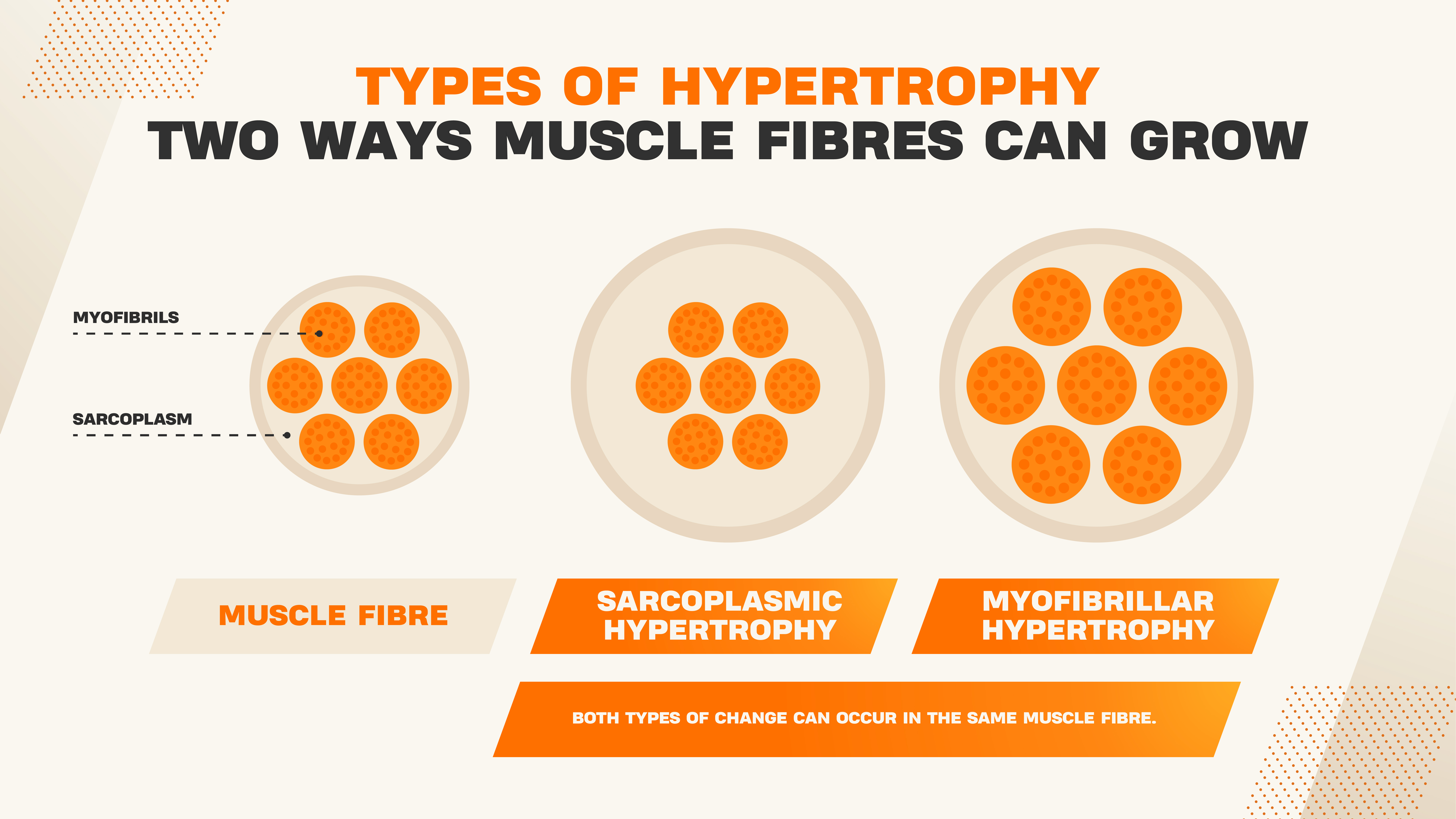
Hypertrophy means that existing muscle fibers become larger. When we talk about muscle hypertrophy, we can distinguish between two forms:
- Myofibrillar hypertrophy: Growth of the structures inside muscle fibers that help muscles contract and produce force.
- Sarcoplasmic hypertrophy: Growth of the fluid inside muscle fibers.
Inside your muscle fibers are structures called myofibrils. These contain proteins that allow your muscles to contract and produce force.
Muscle fibers also contain sarcoplasm. This is the fluid inside the muscle fiber that surrounds the myofibrils.
With sarcoplasmic hypertrophy, the amount of this fluid increases proportionally more than the structures that produce force.
Both types of change can occur in the same muscle fiber, and they cannot simply be separated by using different training methods.
Is hypertrophy training the same as strength training?
Getting stronger is one result of strength training, and muscle growth is another. Getting stronger and building muscle are closely related, but they are not exactly the same thing.
In the beginning, you often get stronger faster than you build muscle. This happens for several reasons. During the first few weeks, for example, your nervous system gets better at activating and coordinating your muscles. Your brain and body learn how to use the muscle mass you already have more effectively.
When you train for maximum strength, the goal is to become as strong as possible in specific movements and to lift heavy weights. With hypertrophy training, the focus is more on effectively loading the muscle itself.
How do muscles grow?
Muscle growth used to be explained quite simply: lifting heavy weights causes tiny tears in your muscles, those tears heal, and that makes the muscle bigger. We now know more about how it works, which helps us train more effectively.
Mechanical tension is considered the main training stimulus for hypertrophy.
This means the tension created when you have to produce force against resistance.
Your body detects that mechanical load and triggers different processes that can eventually contribute to muscle growth.
A review from 2025 describes mechanical tension as the primary stimulus behind hypertrophy. The same review explains that familiar ideas such as the pump, temporary hormone spikes and "cell swelling" are much less important. They can occur during training, but there is not enough evidence that they cause muscle growth on their own.*
What about muscle damage and muscle soreness?
"My muscles are sore, so I pushed my body beyond what it could handle. That means I will get bigger and stronger."
The old theory sounds logical, and sometimes it feels that way too.
Muscle damage can also cause temporary swelling, making your muscles feel fuller or even look bigger. This happens partly because of fluid accumulation during the recovery process. That temporary increase in muscle size does not mean you have built more muscle tissue.
Extreme muscle soreness can affect your performance in your next workout and make it harder to recover properly.
Research even shows that muscles can grow with relatively little muscle damage. Are you doing so many exercises in one session that you can barely train normally for days afterwards? It may be smarter to spread that volume over two sessions.
What happens after a workout?
Your muscles consist largely of proteins. These proteins are constantly being built up and broken down.
Strength training increases the production of new muscle proteins. Protein from food supports this process.
One high spike in muscle protein synthesis after a workout does not automatically mean you will end up building the most muscle. It is the repeated periods of training and recovery that make the difference over time. *
What does an effective training stimulus look like?
Weight, repetitions, sets, rest, exercise selection and progression all play a role.
Weight, repetitions and sets
You can challenge a muscle sufficiently with different weights. What matters most is how challenging each set becomes for the muscle.
For example, your programme says 3 × 15 repetitions. If you stop at 15 even though you could easily do another ten, the set probably wasn't challenging enough. You stopped because you reached the number, not because the muscle was sufficiently challenged.
As a personal trainer, I recommend a repetition range for hypertrophy rather than one fixed number:
- 1 light warm-up set (around 10 repetitions)
- 2 sets of 8 to 15 repetitions, to failure or close to failure
Training to failure means you cannot complete another full repetition with good technique.
Do you need to train every set to failure?
Research shows that you do not have to take every set to complete failure to build muscle. There is no single ideal stopping point that applies to everyone.
In practice, this means the final repetitions of a working set should clearly take effort.
"One possible sign is that the last repetitions unintentionally become slower, even though you are still trying to move forcefully."
Rest, exercise selection and progress
Rest between sets is important. Start your next set when you feel ready to produce maximum force again. Generally, 1.5 to 3 minutes is enough, depending on the exercise and your fitness level.
Imagine doing a Bulgarian split squat with dumbbells. Your glutes and quadriceps are working, but you also have to focus on your balance during every repetition. You may need to adjust your foot position, correct your torso and keep the dumbbells under control.
The set might feel incredibly hard, but balance or stability could be what makes you stop, even though your leg muscles could keep working.
If balance is limiting you, a split squat in a Smith machine can provide additional stability and help you focus on producing force with your glutes and quadriceps.
For hypertrophy, the goal is to create enough mechanical tension in the muscle you're training and let that muscle be the main limiting factor in the set.
"An exercise certainly does not have to be harder to be better for muscle growth."
More sets do not always mean more growth
Doing one light set per muscle group per week is less effective than doing several good sets spread across the week.
But that does not mean twenty sets automatically produce twice as much growth as ten.
As training volume increases, the extra benefit becomes smaller. Extra sets add more stimulus, but they also add more fatigue.
Beginners often need surprisingly little to make progress. You do not have to start with six different exercises for one muscle group.
Start with a simple programme, see whether you are getting stronger and only add sets when there is a good reason to.
For extra guidance with exercise technique, a Basic-Fit personal trainer can help you get started.
Mind-muscle connection: feeling your muscles work
The mind-muscle connection can help you notice whether the muscle you want to train is working. With a biceps curl, it makes sense to feel your biceps.
If you mainly feel your shoulders or lower back because you're swinging the weight, that can be a sign to adjust your technique.
Consciously squeezing a muscle as hard as possible is not necessary for muscle growth. If that focus makes you produce less force or slows the movement unnaturally, it can even work against you.
Use the mind-muscle connection as feedback on your technique. You don't need to feel a muscle as strongly as possible to train it effectively.
Progressive overload: keeping your muscles challenged
Progressive overload means gradually increasing the challenge as your muscles adapt to training.
A weight that felt challenging three months ago may feel light after a while. To keep challenging your muscles, you can do more repetitions or use a little more weight.
When tracking your progress, make sure you maintain the same range of motion and roughly the same technique. This helps you see whether you're actually getting stronger.
What supports muscle growth outside your workouts?
Training provides the stimulus, but your body also needs the resources to respond to it.
Getting enough protein is one part of that. Around 1.6 grams of protein per kilogram of body weight per day is a useful reference point for many people who train. On average, the additional benefit above that amount becomes smaller.
Your total calorie intake matters too. You can lose weight and still gain muscle (especially as a beginner). But with a large calorie deficit, it becomes harder to perform at your best during training and recover from your workouts.
Sleep and general recovery matter as well. If your workouts keep getting worse because you are tired, sleeping poorly or not recovering enough, it becomes harder to keep creating good training stimuli.
Where does hypertrophy training often go wrong?
- You stop because you have reached the prescribed number of repetitions, even though you could have done more
- You make the weight more important than the muscle: Using more weight only counts as progress if you keep performing the exercise in roughly the same way. If your range of motion keeps getting shorter, you start swinging or another muscle takes over, you may simply be moving more weight while loading the target muscle less effectively.
- You keep adding more sets: More volume can lead to additional growth, but more is not endlessly better.
- You chase the pump, muscle soreness or exhaustion
- You change exercises too often: Variety can be useful, but if you do something different every week, it becomes difficult to tell whether you are getting stronger. Keep exercises in your programme long enough to track progress.
How do I start as a beginner?
Choose a simple beginner training programme that you can follow for several weeks. The Basic-Fit app offers workout plans to help you get started and give you a clear routine to follow in the gym.
First, learn to perform the exercises with stability and control, then gradually make your working sets more challenging.
Write down your weights and repetitions to track your progress.
For beginners, two to three training sessions per week are a good starting point. The exact programme matters less than training consistently.
Hypertrophy training: key takeaways
The most important points to remember:
- Create enough mechanical tension in the muscles you want to train.
- Make your working sets challenging. You don't need to reach complete failure every time.
- Gradually increase your weights or repetitions and track your progress.
- Get enough protein, energy and recovery to support muscle growth.
- Stay consistent. Building muscle takes time.
Now it's time to put these tips into practice. Find a strength training plan in the Basic-Fit app and start building a routine that works for you.
Sources
- Van Every et al. (2025). Load-induced human skeletal muscle hypertrophy: Mechanisms, myths, and misconceptions. Journal of Sport and Health Science.
- Damas et al. (2018). The development of skeletal muscle hypertrophy through resistance training: the role of muscle damage and muscle protein synthesis. European Journal of Applied Physiology.
This article is for general information only. Individual needs can vary depending on health status, training experience, and personal goals. If you have a medical condition or specific health concerns, consider seeking advice from a qualified healthcare professional


