



If you run several times a week, you've probably thought it before: “I know I should do some strength training, but I don't know where to start.”
And that's completely normal. Between your easy runs, interval sessions, long runs, and everything else that fills your week, finding time for strength training can seem difficult. It's also common to wonder whether it will leave you too tired, affect your running, or even be worth the effort.
The good news is that you don't need to spend hours in the gym to see benefits. A few well-planned sessions can help you run stronger, improve your efficiency, and better prepare your body for the miles ahead.
In this guide, you'll discover how much strength training a runner really needs, which exercises are most worthwhile, and how to combine it with your running without making life complicated.

Does strength training really help you run better?
Yes. Strength training can help you run more efficiently, with greater stability and less strain.
Every time you run, your body absorbs and generates force over and over again. With every stride, one leg has to absorb impact, stabilize your body, and propel you forward again.
When your muscles, tendons, and joints are better prepared to do this, running usually feels easier and more controlled.
- Better running economy: you can use less energy to maintain the same pace.*
- More power: hills, pace changes, and finishing sprints depend on your ability to generate force.*
- More stability: strong glutes, legs, and core help you maintain better running form when fatigue sets in.*
- Lower risk of overuse injuries: a stronger body generally tolerates the repetitive impact of running better.*
That's why strength training can be one of the best ways to support your running. You don't need to replace miles with hours in the gym. You simply need to add enough strength work to help your body perform better.
How many times a week should a runner do strength training?
You don't need to do strength training every day. The goal is to complement your mileage, not replace it.
For most runners, between 1 and 3 sessions per week is enough:
- 1 session per week: the minimum effective dose. Ideal if you're short on time, running high mileage, or just getting started.
- 2 sessions per week: the sweet spot for most runners. It allows you to build strength without accumulating too much fatigue.
- 3 sessions per week: useful during the off-season or if you want to build a strength base before preparing for a demanding race.
Strength programs for runners tend to work best when followed for several weeks, because the body needs time to adapt.* That's why consistency matters more than perfection.
It's better to do 20 to 30 minutes every week for months than to attempt a perfect two-hour routine and quit after a short time.

What is the minimum effective routine?
The minimum effective routine is a short session that targets your legs, glutes, calves, and core.
You don't need to do 12 exercises or change your routine every week. To get started, you need basic movements that help you run with more strength and stability.
A simple gym session for runners could include:
- A leg exercise, such as squats, lunges, or step-ups.
- A hip-focused exercise, such as Romanian deadlifts, hip thrusts, or glute bridges.
- A unilateral exercise, because running happens one leg at a time.
- An exercise for your calves and ankles: important for generating momentum while running and keeping the structures that support each stride strong.
- A core exercise, to maintain stability when fatigue sets in.
For example:
- Goblet squat: 3 sets of 8 to 10 repetitions
- Dumbbell Romanian deadlift: 3 sets of 8 to 10 repetitions
- Split squat: 2 sets of 8 repetitions per leg
- Hip thrust: 3 sets of 10 repetitions
- Standing calf raise: 3 sets of 12 repetitions
- Side plank: 2 sets of 30 seconds per side
With that, you already have a very solid foundation.
If you're struggling to organize it all, the Basic-Fit app makes it easier with Feel Stronger Every Run. Each program includes 2 strength sessions per week, designed to complement your running training without leaving everything to chance.
The most important exercises for runners
The best exercises aren't necessarily the most complicated ones. They're the ones that reinforce the movement patterns you need when running: pushing, stabilizing, absorbing impact, and maintaining good posture.
| Exercise | Sets and reps | Why do it |
|---|---|---|
| Goblet Squat | 3 × 10–12 | Strengthens the legs and improves upper body posture. |
| Romanian Deadlift | 3 × 8–10 | Key for strengthening the glutes and hamstrings. |
| Lunges | 3 × 10 per leg | Builds unilateral strength and stability. |
| Glute Bridge | 3 × 12–15 | Helps activate the glutes and improve pelvic control. |
| Calf Raises | 3 × 12–15 | Strengthens the calves, soleus and Achilles tendon. |
| Plank | 3 × 45–60 sec | Helps maintain a stable posture while running. |
You don't need to change exercises every week. Repeating the same movements for several weeks will help you improve technique, manage training load more effectively, and see real progress.
Trainer's tip: if you don't know where to start, look for the Feel Stronger Every Run experience in the Basic-Fit app. You'll find programs organized according to how much time you have before your race: 12, 10, 8, 6, or 4 weeks.
Should runners lift heavy or light weights?
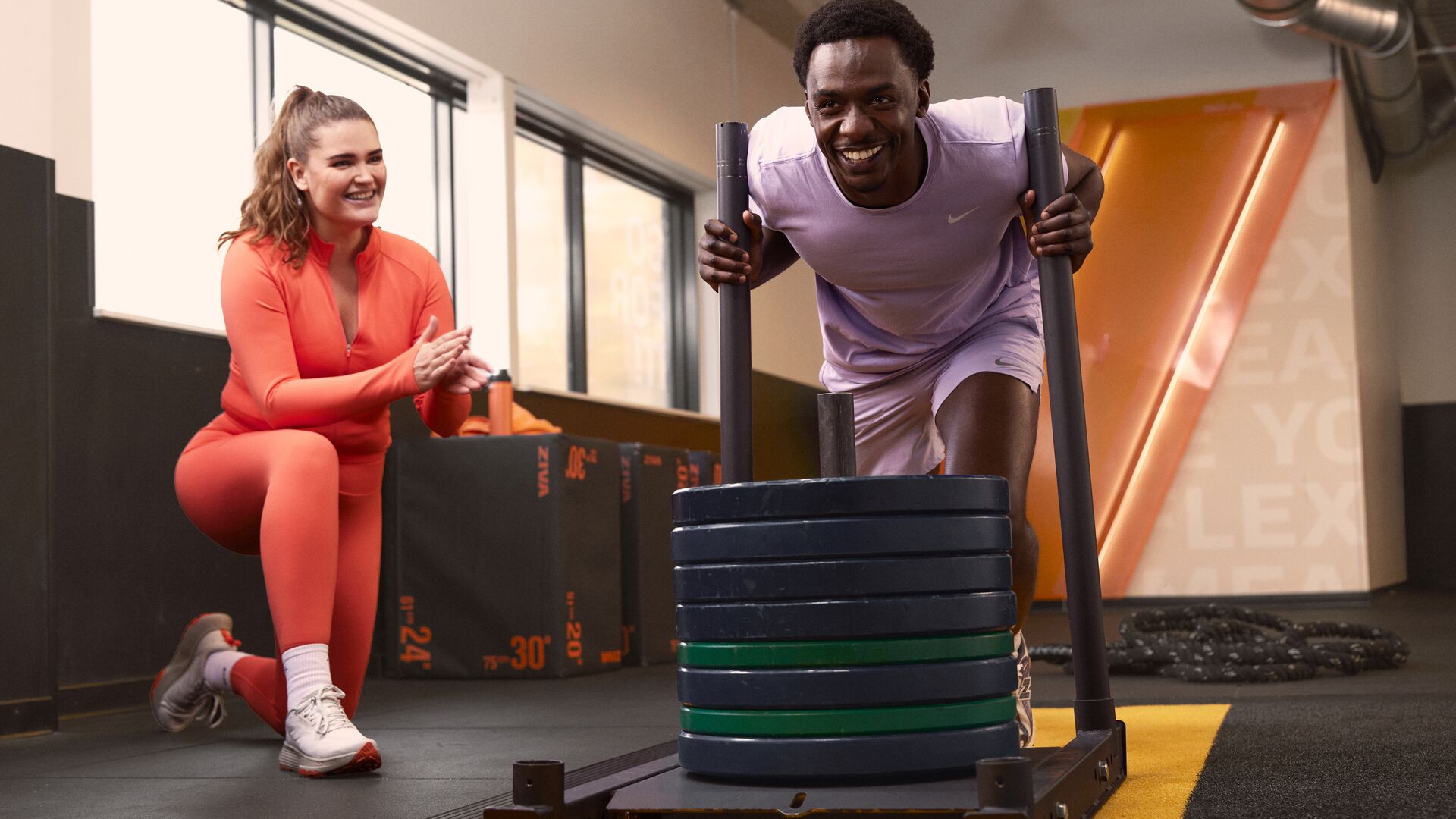
There's a myth that runners should only lift light weights and do lots of repetitions to "tone up." But if you want to improve your strength, power, and running economy, lifting moderate to heavy loads can be very beneficial.*
This doesn't mean attempting one-rep maxes or training to your limit. It means choosing a load that challenges you while maintaining good technique.
- Light loads: useful for learning technique or recovering during demanding training weeks.
- Moderate loads: ideal for most runners.
- Heavy loads: useful if you already have experience and solid technique.
By lifting heavier weights, you teach your nervous system to produce force more efficiently.* This can help you run better without needing to gain a lot of muscle mass.*
And no, strength training won't automatically make you slower. Building a lot of muscle requires high training volume, plenty of calories, and a hypertrophy-focused plan. A strength routine for runners aims for the opposite: improving performance without adding unnecessary fatigue.
How to combine strength training and running without burning out
Weekly planning is often the hardest part. You can have a great routine, but if you schedule it poorly, you'll end up with heavy legs exactly when you need to run well.
These rules will help:
- Avoid hard strength sessions before your long run.
- If you do a hard leg session the day before, it's normal to run worse.
- Don't stack too much intensity.
- Hard intervals and heavy strength training on the same day can be too much if you're not used to it.
- If you do both on the same day, decide what your priority is.
- If your priority is improving your running, run first and do strength training afterward, ideally leaving a few hours between sessions.
- Adjust according to how you feel.
- If you're coming off a hard workout, reduce the load or do a lighter session.
One advantage of Feel Stronger Every Run in our app is that it doesn't just give you strength workouts. Each week also includes a blog related to that stage of training and an optional run aligned with the week's focus. That way, you're not only training, you're also understanding why you're doing each part of the plan.
A simple weekly example
There is no perfect training week for everyone, but this structure can work well if you run 3 or 4 days per week:
- Monday: strength training
- Tuesday: easy run
- Wednesday: rest or mobility work
- Thursday: intervals or a quality workout
- Friday: strength training
- Saturday: rest or a very easy run
- Sunday: long run
If you run 5 days per week, you can keep 1 or 2 shorter strength sessions, avoiding scheduling them right before your key workouts.
If you'd rather not build your week from scratch, you can follow one of the Feel Stronger Every Run programs in the app. They're designed to help you prepare for your race by combining strength training, education, and optional running support week by week.
Can strength training help you avoid injuries?
Most running injuries don't happen because of a single bad step, but because of accumulated training load.
Runner's knee, Achilles tendon issues, hip pain, plantar fasciitis, or calf strains often have one thing in common: the body is receiving more impact than it can tolerate at that moment.
Strength training helps because it improves your ability to absorb, control, and generate force.* Strong glutes help stabilize the hips. Strong calves and soleus muscles provide better ankle support. A stable core helps maintain better posture.
That doesn't mean strength training completely eliminates the risk of injury. No training program can promise that. However, it can help your body become better prepared to handle the repetitive demands of running.*
Start today
Don't wait until you're injured to start strength training. The best time to get stronger is when you're feeling good.
You don't need marathon-length sessions, complicated machines, or a different routine every week. Start with a consistent 20 to 30 minutes, focus on the basics, and give your body time to adapt.
And if you want to make it even easier, open the Basic-Fit app and search for Feel Stronger Every Run. Choose the program that best fits the time remaining until your next race or event, follow your weekly strength sessions, and use the blogs for each phase to better understand how to prepare your body.
All you need to do is show up at the club, hit "play," and start building a stronger, more efficient runner's body that's ready to perform better.
See you on the road... and in the gym.
Sources
- Blagrove, R. C., Howatson, G., & Hayes, P. R. (2018). Effects of strength training on the physiological determinants of middle- and long-distance running performance: A systematic review. Sports Medicine, 48(5), 1117–1149. https://doi.org/10.1007/s40279-017-0835-7
- Denadai, B. S., de Aguiar, R. A., de Lima, L. C. R., Greco, C. C., & Caputo, F. (2017). Explosive training and heavy weight training are effective for improving running economy in endurance athletes: A systematic review and meta-analysis. Sports Medicine, 47(3), 545–554. https://doi.org/10.1007/s40279-016-0604-z
- Llanos-Lagos, C., Ramirez-Campillo, R., Moran, J., & Sáez de Villarreal, E. (2024). Effect of strength training programs on middle- and long-distance runners’ economy at different running speeds: A systematic review with meta-analysis. Sports Medicine, 54, 895–932. https://doi.org/10.1007/s40279-023-01978-y
- Paavolainen, L., Häkkinen, K., Hämäläinen, I., Nummela, A., & Rusko, H. (1999). Explosive-strength training improves 5-km running time by improving running economy and muscle power. Journal of Applied Physiology, 86(5), 1527–1533. https://doi.org/10.1152/jappl.1999.86.5.1527
This article is for informational purposes only. Individual needs may vary depending on health status, training experience, and personal goals. If you have a medical condition or specific concerns about your health, consult a qualified healthcare professional.


